Introduction
The Oil & Gas industry is perhaps the most high-stakes environment for asset maintenance. Traditionally, inspecting an offshore rig, a flame tower (flare stack), or a storage tank involved shutting down operations (turnarounds) and sending humans into high-risk areas via scaffolding or rope access.
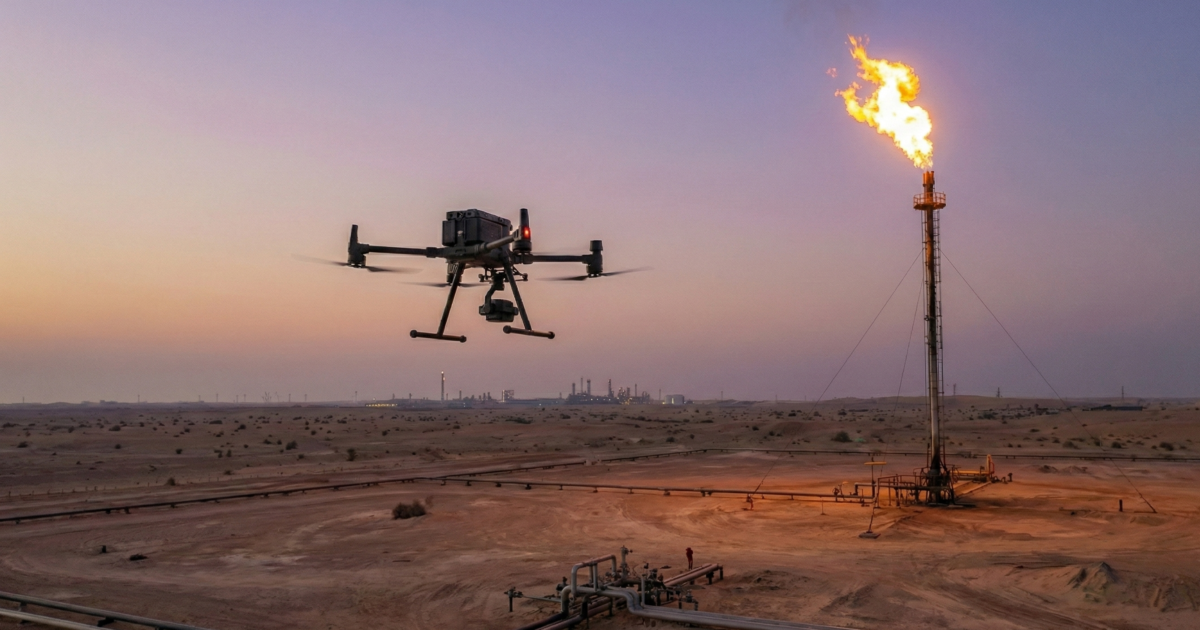
Drone technology has fundamentally changed this, allowing for “Live Flare” inspections and high-detail structural analysis without stopping production. For a company in the UAE’s energy sector to adapt, specific specialized equipment and stringent safety protocols are required.
High-Value Assets: What Are We Inspecting?
Flare Stacks (Flame Towers)
Inspecting the “tip” of a flare stack is notoriously difficult due to extreme heat.
- The Drone Advantage: Using high-zoom thermal sensors, drones can inspect the pilot light, burner tips, and structural integrity while the flare is operational.
Oil Rigs (Offshore and Onshore)
Rigs face constant corrosion from salt spray and harsh winds. Drones scan the derrick, the underside of platforms, and the hull of FPSOs (Floating Production Storage and Offloading).
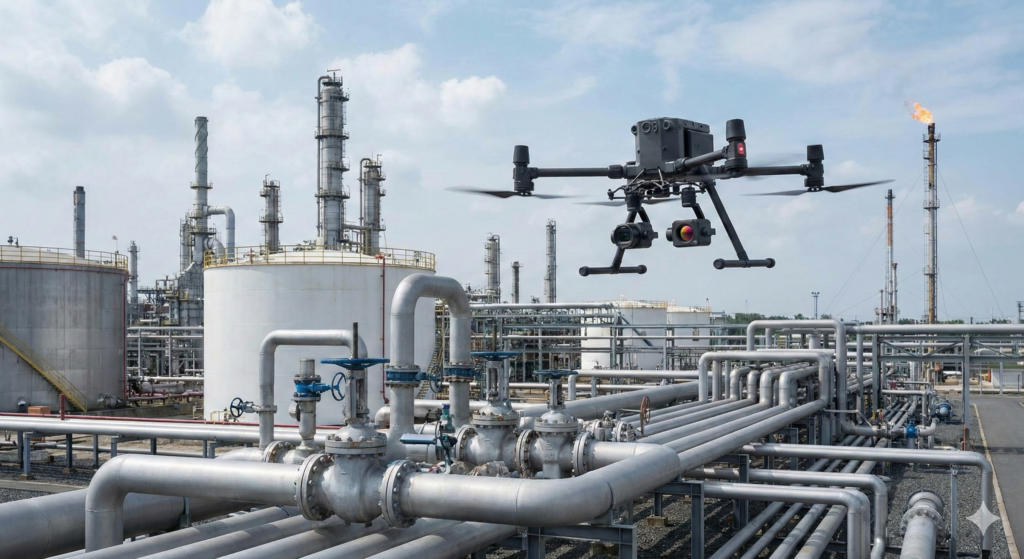
Storage Tanks and Pipelines
Drones equipped with ultrasonic sensors or gas leak detectors (OGI) can scan vast lengths of pipeline and large tank roofs for leaks or corrosion.
Specialized Equipment for Oil & Gas
Standard consumer drones cannot survive the magnetic interference and hazardous environments of an oil field.
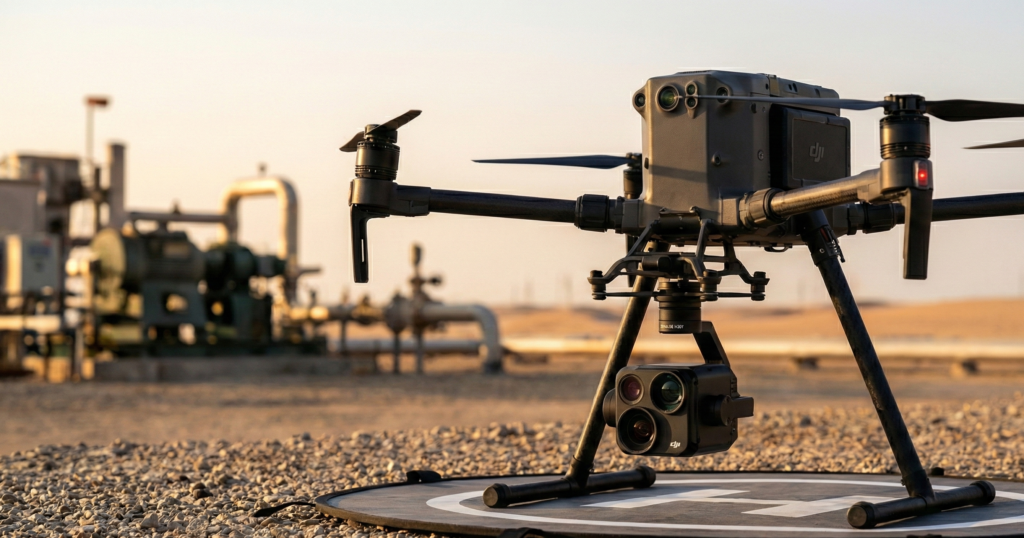
The Drone: DJI Matrice 350 RTK (High-Reliability)
The M350 is the industry workhorse for oil & gas due to its anti-magnetic interference capabilities and weather shielding.
The Sensors:
- DJI Zenmuse H30T (Multispectral/Thermal): Features a 34x optical zoom and high-resolution thermal imaging. This allows the drone to stay 30+ meters away from a hot flare while seeing a 1cm crack in the burner tip.
- Optical Gas Imaging (OGI) Payloads ( e.g Sniffer4D ) : Specialized sensors that can “see” methane or VOC leaks that are invisible to the naked eye.
Software and Data Management
Data in Oil & Gas must be “Auditable” and “Secure.”
- DJI FlightHub 2: For real-time mission management. It allows an HSE officer in a Dubai office to watch the live feed of an offshore rig inspection.
- Asset Management Platforms ( e.g. Sniffer4D Mapper ) : Software that organizes thousands of inspection photos into a 3D model of the rig, highlighting “Red Flag” areas for immediate attention, or live data structuring and monitoring.
Manpower and Safety Requirements
In the Energy sector, the “Pilot” is only half the requirement.
- Certified Pilot: Must have specialized training for flying in “ATEX” (Explosive Atmosphere) zones or near high-EMF (Electromagnetic Field) sources.
- Asset Integrity Engineer: A subject matter expert who reviews the drone footage and reports/dashboards in real-time to identify critical defects.
- HSE Lead: To ensure the drone flight plan doesn’t interfere with rig operations or personnel safety.
Summary Checklist for Oil & Gas Adaptation
| Requirement | Solution |
|---|---|
| Drone Platform | DJI Matrice 350/400 RTK (Weatherproofed) |
| Primary Sensor | Zenmuse H30T (Visual + Thermal + Laser Rangefinder) |
| Specialized Sensor | OGI (Optical Gas Imaging) for leak detection |
| Safety Certification | Offshore Survival Training (BOSIET) for pilots |
| Data Platform | DJI FlightHub 2 (Secure Cloud Management) |
Conclusion: Maximizing Uptime
For Oil & Gas companies, drones are the ultimate tool for “Preventative Maintenance.” By identifying corrosion on a rig or a blockage in a flare tip months before it causes a shutdown, companies save millions in lost production. In the UAE’s competitive energy landscape, this technology is the key to operational resilience.
Contact us today to learn how ZID can design a custom drone inspection program for your industrial assets.
Internal Links: