Introduction
Digital transformation has become one of the most discussed topics in business, yet it remains one of the most misunderstood. Studies suggest that 70% of digital transformation initiatives fail to achieve their intended outcomes, despite significant investments in technology, time, and resources. Why do so many organizations struggle with digital transformation, and what separates successful initiatives from failures?
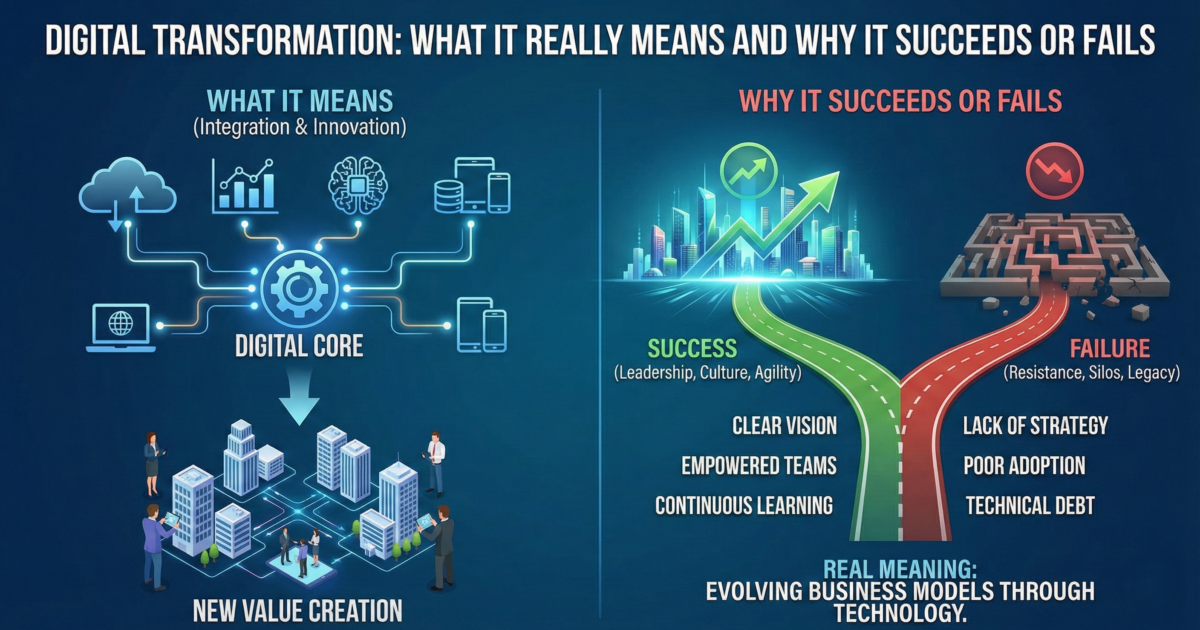
The answer lies in understanding what digital transformation really means. It’s not about buying new software, implementing cloud solutions, or adopting the latest technology trends. True digital transformation is a fundamental reimagining of how organizations operate, deliver value, and compete in a digital world.
This article explores what digital transformation actually means, why most initiatives fail, what makes successful transformations work, and how organizations can increase their chances of success.
What Digital Transformation Really Means
Beyond Technology Adoption
Many organizations mistake digital transformation for technology adoption:
Technology Adoption:
- Implementing new software systems
- Moving to cloud platforms
- Adopting mobile applications
- Upgrading hardware and infrastructure
Digital Transformation:
- Rethinking business models and processes
- Changing how value is created and delivered
- Transforming customer experiences
- Building new capabilities and competencies
The Core Components
Digital transformation involves four fundamental components:
1. Process Transformation:
- Redesigning workflows and operations
- Automating routine tasks
- Eliminating inefficiencies
- Creating new ways of working
2. Business Model Transformation:
- Rethinking how value is created
- Exploring new revenue streams
- Changing customer relationships
- Adapting to digital marketplaces
3. Domain Transformation:
- Expanding into new business areas
- Leveraging data for new services
- Creating digital products
- Building platform businesses
4. Cultural Transformation:
- Fostering innovation and experimentation
- Embracing change and agility
- Developing digital skills
- Creating data-driven decision-making
A Holistic Approach
Digital transformation is holistic—it affects:
- Strategy: How organizations compete and win
- Operations: How work gets done
- Customer Experience: How customers interact with the organization
- Culture: How people think and behave
- Technology: What tools and systems are used
- Data: How information is collected, analyzed, and used
Why Digital Transformations Fail
Failure Pattern 1: Technology-First Thinking
The Problem:
Organizations start with technology solutions rather than business problems. They ask “What technology should we adopt?” instead of “What problems are we trying to solve?”
Why It Fails:
- Technology doesn’t address real business needs
- Solutions don’t integrate with existing processes
- Users resist because value isn’t clear
- Investments don’t deliver expected returns
The Solution:
Start with business objectives, identify problems, then find technology solutions that address them.
Failure Pattern 2: Lack of Clear Vision
The Problem:
Organizations embark on digital transformation without a clear vision of what they’re trying to achieve. Vague goals like “become more digital” or “improve efficiency” don’t provide direction.
Why It Fails:
- No clear success criteria
- Conflicting priorities
- Lack of alignment across organization
- Resources spread too thin
- Inability to measure progress
The Solution:
Define specific, measurable objectives. What exactly are you trying to achieve? How will you measure success?
Failure Pattern 3: Insufficient Leadership Commitment
The Problem:
Digital transformation requires significant change, but leadership isn’t fully committed or doesn’t stay committed throughout the journey.
Why It Fails:
- Initiatives lose momentum
- Resources get reallocated
- Competing priorities take precedence
- Change resistance isn’t addressed
- Long-term commitment wavers
The Solution:
Ensure executive sponsorship, visible leadership support, and sustained commitment throughout the transformation.
Failure Pattern 4: Resistance to Change
The Problem:
People resist new ways of working. They’re comfortable with existing processes, fear job loss, or don’t understand the benefits.
Why It Fails:
- Employees don’t adopt new systems
- Workarounds maintain old processes
- Change initiatives stall
- Cultural barriers prevent progress
- Transformation doesn’t take root
The Solution:
Invest in change management, communicate benefits clearly, involve employees in design, and provide training and support.
Failure Pattern 5: Poor Integration and Silos
The Problem:
New digital solutions are implemented in isolation, creating silos rather than integrated systems.
Why It Fails:
- Data doesn’t flow between systems
- Processes remain fragmented
- Users must work across multiple platforms
- Inefficiencies persist
- Value isn’t realized
The Solution:
Design for integration from the start. Ensure new solutions connect with existing systems and processes.
Failure Pattern 6: Inadequate Skills and Capabilities
The Problem:
Organizations lack the skills needed to execute digital transformation effectively.
Why It Fails:
- Technical skills gaps
- Lack of digital literacy
- Insufficient change management capabilities
- Missing data analytics expertise
- Inability to maintain new systems
The Solution:
Invest in training, hire new talent, partner with experts, and build capabilities over time.
Failure Pattern 7: Unrealistic Expectations
The Problem:
Organizations expect immediate results and dramatic improvements without understanding that transformation takes time.
Why It Fails:
- Early setbacks cause abandonment
- Patience runs out before value materializes
- Unrealistic timelines create pressure
- Quick wins aren’t recognized
- Long-term commitment falters
The Solution:
Set realistic expectations, plan for a multi-year journey, celebrate incremental progress, and maintain long-term commitment.
What Makes Digital Transformations Succeed
Success Factor 1: Clear Business Objectives
Successful transformations start with clear business objectives:
- Specific problems to solve
- Measurable outcomes to achieve
- Defined success criteria
- Alignment with business strategy
- Connection to customer value
Example:
Instead of “implement cloud computing,” a successful transformation might aim to “reduce customer service response time by 50% through automated workflows and self-service portals.”
Success Factor 2: Strong Leadership and Vision
Successful transformations have:
- Executive sponsorship: Top leadership actively supports the initiative
- Clear vision: Everyone understands where the organization is heading
- Consistent communication: Regular updates on progress and benefits
- Resource commitment: Adequate budget and personnel allocated
- Long-term perspective: Sustained commitment over years, not months
Success Factor 3: Customer-Centric Focus
Successful transformations prioritize customer value:
- Understanding customer needs and pain points
- Designing solutions that improve customer experience
- Measuring success by customer outcomes
- Continuously iterating based on customer feedback
- Creating competitive advantages through superior customer experience
Success Factor 4: Incremental Approach
Successful transformations proceed incrementally:
- Start with pilot programs
- Learn and adjust based on results
- Scale successful initiatives
- Build momentum through quick wins
- Maintain flexibility to adapt
Benefits:
- Lower risk
- Faster learning
- Early value realization
- Easier course correction
- Sustained momentum
Success Factor 5: Cultural Transformation
Successful transformations change culture:
- Foster innovation and experimentation
- Embrace failure as learning opportunity
- Develop data-driven decision-making
- Encourage collaboration and cross-functional work
- Build digital skills throughout organization
Success Factor 6: Integration and Holistic Thinking
Successful transformations integrate systems:
- Connect new solutions with existing infrastructure
- Ensure data flows across systems
- Create unified user experiences
- Eliminate process silos
- Build comprehensive capabilities
Success Factor 7: Change Management Excellence
Successful transformations manage change effectively:
- Communicate vision and benefits clearly
- Involve employees in design and implementation
- Provide comprehensive training and support
- Address concerns and resistance
- Celebrate successes and recognize contributions
The Digital Transformation Readiness Assessment
Evaluate Your Organization’s Readiness
Strategic Readiness:
- ✅ Do we have clear digital transformation objectives?
- ✅ Is our vision aligned across the organization?
- ✅ Do we understand what success looks like?
- ✅ Is digital transformation a strategic priority?
Leadership Readiness:
- ✅ Do executives actively support transformation?
- ✅ Is there sustained commitment to the initiative?
- ✅ Are resources allocated appropriately?
- ✅ Is change management a priority?
Cultural Readiness:
- ✅ Is our organization open to change?
- ✅ Do we encourage innovation and experimentation?
- ✅ Are we comfortable with data-driven decisions?
- ✅ Do we have digital skills in the organization?
Technical Readiness:
- ✅ Do we have the technical capabilities needed?
- ✅ Is our infrastructure ready for new solutions?
- ✅ Can we integrate new systems with existing ones?
- ✅ Do we have data management capabilities?
Process Readiness:
- ✅ Are our processes well-defined?
- ✅ Can we redesign workflows effectively?
- ✅ Do we understand our current inefficiencies?
- ✅ Are we ready to eliminate outdated processes?
Scoring Your Readiness
- High Readiness (18-20 “Yes”): Your organization is well-positioned for digital transformation
- Medium Readiness (12-17 “Yes”): Address gaps before proceeding, or start with focused initiatives
- Low Readiness (0-11 “Yes”): Focus on foundational improvements before major transformation
Common Misconceptions About Digital Transformation
Misconception 1: “It’s About Technology”
Reality: Technology is an enabler, but transformation is about business change. The focus should be on improving operations, customer experience, and business outcomes.
Misconception 2: “It’s a One-Time Project”
Reality: Digital transformation is an ongoing journey, not a project with an end date. It requires continuous adaptation and evolution.
Misconception 3: “It’s Only for Tech Companies”
Reality: Every organization, regardless of industry, can benefit from digital transformation. It’s about using digital capabilities to improve how you operate.
Misconception 4: “It Requires Replacing Everything”
Reality: Successful transformations often build on existing systems, integrating new capabilities rather than replacing everything.
Misconception 5: “It’s Expensive and Risky”
Reality: While transformation requires investment, incremental approaches can manage risk and cost. The bigger risk is not transforming and falling behind competitors.
Practical Steps for Success
Step 1: Define Clear Objectives
Start with specific business problems:
- What inefficiencies are we trying to eliminate?
- What customer experiences are we trying to improve?
- What new capabilities do we need?
- What competitive advantages are we building?
Step 2: Assess Current State
Understand where you are:
- What digital capabilities do we have?
- What processes need improvement?
- What skills are missing?
- What systems need integration?
Step 3: Develop a Roadmap
Create a phased approach:
- Quick wins for early momentum
- Foundation-building initiatives
- Major transformation programs
- Continuous improvement activities
Step 4: Start Small
Begin with pilot programs:
- Select focused areas for initial transformation
- Learn and adjust based on results
- Build capabilities incrementally
- Scale successful initiatives
Step 5: Invest in Change Management
Support the people side:
- Communicate vision and benefits
- Provide training and support
- Address concerns and resistance
- Celebrate progress and successes
Step 6: Measure and Adjust
Track progress continuously:
- Define key performance indicators
- Monitor progress regularly
- Adjust approach based on results
- Learn from both successes and failures
Conclusion
Digital transformation succeeds when organizations understand that it’s fundamentally about business transformation enabled by technology, not technology adoption for its own sake. Success requires:
- Clear objectives that address real business problems
- Strong leadership committed to long-term change
- Customer-centric focus that creates value
- Incremental approach that manages risk and builds momentum
- Cultural change that embraces new ways of working
- Integration thinking that connects systems and processes
- Change management that supports people through transformation
Most failures occur because organizations focus on technology while neglecting the business, cultural, and human factors that determine success. Understanding what digital transformation really means—and what makes it succeed or fail—is the first step toward ensuring your initiative delivers real value.
The question isn’t whether your organization needs digital transformation—it’s whether you’ll approach it in a way that ensures success or sets you up for failure. The difference lies in understanding that transformation is about changing how you operate, not just what technology you use.
Ready to Transform Successfully?
At ZID – Zenith InnoDev, we understand that successful digital transformation requires more than technology—it requires business understanding, change management, and strategic thinking. With 11+ years of engineering expertise and experience in technology integration, we help organizations navigate digital transformation successfully.
Our approach combines technical expertise with business acumen, ensuring that digital initiatives deliver real value. We help define objectives, assess readiness, develop roadmaps, and execute transformations that succeed.
Contact us today to discuss how we can help ensure your digital transformation delivers the results you need.
Internal Links: