Introduction
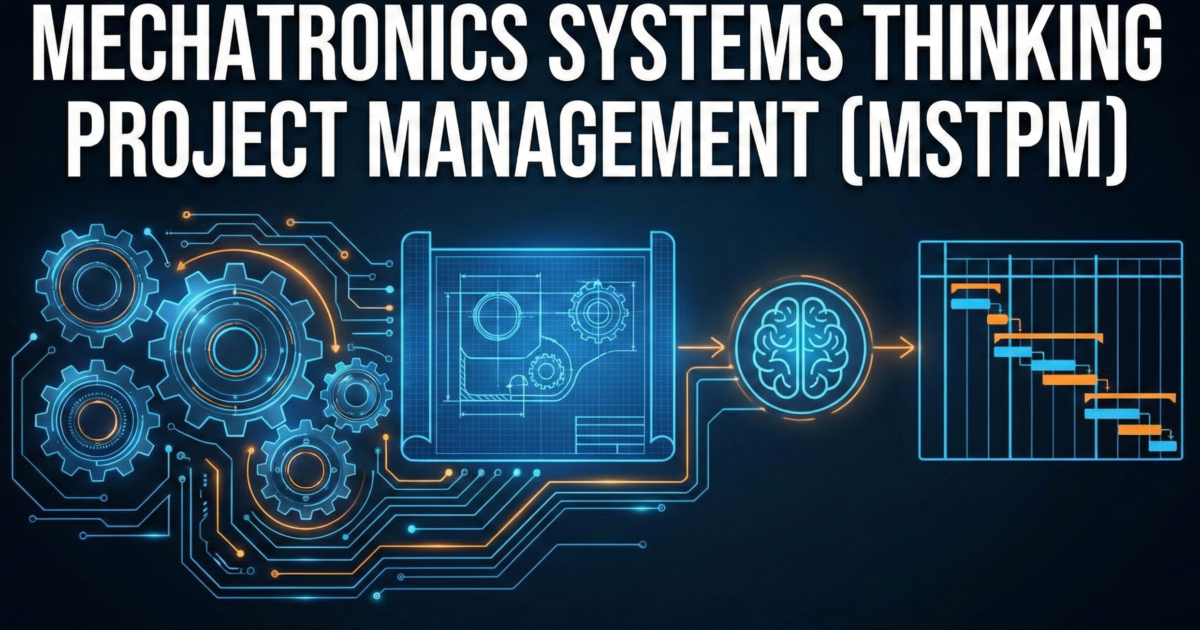
After 11+ years working in mechatronics engineering, I’ve discovered something unexpected: the principles that make mechatronic systems work are the same principles that make projects succeed. This isn’t a coincidence—both involve complex, interconnected systems where mechanical, electrical, and software components must work together seamlessly.
Most project managers think in linear terms: step one, step two, step three. But real projects are more like mechatronic systems—they’re dynamic, interconnected, and require systems thinking to manage effectively. Understanding this connection can transform how you approach project management, leading to better outcomes, fewer surprises, and more successful deliveries.
This article explores how the mechatronics mindset—systems thinking, integration awareness, and holistic problem-solving—applies to project management, revealing insights that can dramatically improve your project success rate.
What Is the Mechatronics Mindset?
Understanding Mechatronics
Mechatronics is the integration of mechanical engineering, electronics, computer science, and control engineering. A mechatronic system isn’t just a collection of parts—it’s an integrated whole where mechanical components, sensors, actuators, and software work together to achieve a common goal.
The Core Principles
The mechatronics mindset involves:
- Systems Thinking: Understanding how components interact and affect each other
- Integration Awareness: Recognizing that changes in one area impact others
- Holistic Problem-Solving: Addressing root causes, not just symptoms
- Feedback Loops: Using information to continuously adjust and improve
- Emergent Properties: Understanding that system behavior emerges from interactions
Why This Matters for Projects
Projects are complex systems with multiple interconnected components:
- Stakeholders with different interests and priorities
- Resources (time, budget, people) that are interdependent
- Tasks that have dependencies and interactions
- Risks that can cascade through the system
- Changes that affect multiple areas simultaneously
Thinking linearly about these interconnected elements leads to project failures.
The Linear Thinking Trap
How Most Projects Are Managed
Traditional project management often follows a linear approach:
- Plan everything upfront in detail
- Execute tasks in sequence
- Monitor progress against the plan
- Fix problems as they arise
- Deliver when tasks are complete
This approach works for simple projects but fails when complexity increases.
Why Linear Thinking Fails
Linear thinking assumes:
- Independence: Tasks can be managed separately
- Predictability: Everything will go according to plan
- Isolation: Problems are contained and don’t affect other areas
- Sequential execution: One thing happens after another
Real projects are characterized by:
- Interdependence: Tasks affect each other in unexpected ways
- Uncertainty: Unforeseen issues arise constantly
- Cascading effects: Problems in one area create problems elsewhere
- Parallel complexity: Multiple things happen simultaneously
Real-World Example
A construction project manager planned a linear sequence: foundation → structure → MEP (mechanical, electrical, plumbing) → finishing. However, when foundation work was delayed, it didn’t just push everything back—it created cascading effects:
- Structural work couldn’t begin, but materials were already ordered
- MEP contractors were scheduled but now had conflicts
- Finishing materials were in storage, incurring costs
- Weather windows were missed, creating further delays
Linear thinking saw these as separate problems. Systems thinking would have recognized the interdependencies and planned for them.
Systems Thinking in Project Management
Understanding Project Systems
Every project is a system with:
- Components: Tasks, resources, stakeholders, deliverables
- Interactions: Dependencies, communications, workflows
- Boundaries: Scope, timeline, budget constraints
- Environment: External factors, market conditions, regulations
- Purpose: Project objectives and success criteria
The Systems Thinking Approach
Systems thinking in project management means:
- Mapping relationships: Understanding how components connect
- Identifying feedback loops: Recognizing reinforcing and balancing cycles
- Seeing patterns: Understanding recurring behaviors and issues
- Finding leverage points: Identifying where small changes create big impacts
- Anticipating cascades: Preparing for how problems propagate
Practical Application: Dependency Mapping
Instead of just listing tasks, systems thinking involves:
- Identifying dependencies: What depends on what?
- Mapping critical paths: Which dependencies create bottlenecks?
- Understanding interactions: How do tasks affect each other?
- Planning buffers: Where do we need flexibility?
- Designing feedback: How do we know when to adjust?
Integration Awareness: The Mechatronics Principle
In Mechatronic Systems
In mechatronics, changing one component affects others:
- Adjusting a sensor sensitivity changes control behavior
- Modifying mechanical design affects software requirements
- Changing software logic impacts mechanical performance
Engineers must consider these interactions when making changes.
In Project Management
Similarly, project changes have ripple effects:
Scope Changes:
- Affect timeline (more work = more time)
- Impact budget (more resources needed)
- Require stakeholder communication
- May affect quality if rushed
- Could create new risks
Timeline Changes:
- Affect resource availability
- Impact budget (overtime, expedited materials)
- May require scope reduction
- Create cascading schedule impacts
- Affect stakeholder expectations
Resource Changes:
- Impact timeline (different productivity)
- Affect quality (skill levels vary)
- Require knowledge transfer
- Create communication challenges
- May affect team dynamics
The Integration Mindset
Project managers with integration awareness:
- Consider ripple effects before making changes
- Communicate impacts to all affected parties
- Plan for interactions when designing solutions
- Monitor cascades when problems arise
- Design integrated solutions that address multiple areas
Holistic Problem-Solving
Symptom vs. Root Cause
Linear thinking often addresses symptoms:
- Symptom: Project is behind schedule
- Linear solution: Work faster, add resources, extend deadline
Systems thinking addresses root causes:
- Root cause analysis: Why is the project behind?
- Unrealistic initial estimates?
- Scope creep?
- Resource constraints?
- Communication breakdowns?
- External dependencies?
- Holistic solution: Address root causes, not just symptoms
The Mechatronics Approach
In mechatronics, when a system fails, engineers don’t just replace parts. They:
- Understand the failure mode: How did it fail?
- Analyze root causes: Why did it fail?
- Consider system interactions: What else might be affected?
- Design comprehensive solutions: Fix root causes, not symptoms
- Test system-wide: Ensure the fix doesn’t create new problems
Applying to Projects
When projects have problems:
- Understand the problem: What’s really happening?
- Analyze root causes: Why is this happening?
- Consider system impacts: What else is affected?
- Design integrated solutions: Address root causes holistically
- Monitor system-wide: Ensure solutions don’t create new issues
Feedback Loops and Adaptive Management
Control Systems in Mechatronics
Mechatronic systems use feedback loops:
- Sensors measure current state
- Controllers compare to desired state
- Actuators make adjustments
- System responds to changes
- Sensors measure again (feedback loop)
This creates continuous adjustment and improvement.
Feedback in Project Management
Projects also need feedback loops:
- Monitor: Track progress, quality, risks, stakeholder satisfaction
- Compare: Assess against plans, objectives, success criteria
- Adjust: Make changes to plans, resources, approaches
- Execute: Implement adjustments
- Monitor again: Close the feedback loop
The Adaptive Approach
Instead of rigid plans, adaptive project management:
- Plans iteratively: Creates detailed plans for near-term work
- Monitors continuously: Tracks progress and changes
- Adjusts frequently: Makes course corrections regularly
- Learns constantly: Incorporates lessons into future planning
- Responds quickly: Adapts to new information and conditions
Emergent Properties: When the Whole Is More Than the Sum of Parts
In Mechatronic Systems
Mechatronic systems exhibit emergent properties—behaviors that arise from component interactions but aren’t present in individual components:
- A robot’s ability to navigate emerges from sensor integration, control algorithms, and mechanical design working together
- System reliability emerges from component redundancy and error handling
- Performance characteristics emerge from optimization across subsystems
In Projects
Projects also have emergent properties:
- Team synergy: High-performing teams emerge from individual contributions
- Project culture: Work environment emerges from leadership, communication, and processes
- Innovation: Creative solutions emerge from diverse perspectives and collaboration
- Momentum: Project velocity emerges from alignment, clarity, and execution
- Quality: Deliverable quality emerges from processes, standards, and attention to detail
Managing Emergent Properties
You can’t directly control emergent properties, but you can influence them:
- Foster team collaboration to encourage synergy
- Create positive culture through leadership and communication
- Encourage diverse input to stimulate innovation
- Maintain alignment to build momentum
- Establish quality processes to ensure good outcomes
The Self-Assessment: Are You Thinking Systemically?
Evaluate Your Systems Thinking
Ask yourself these questions about your project management approach:
Systems Awareness:
- Do I understand how project components interact?
- Can I map dependencies and relationships?
- Do I consider ripple effects when making changes?
Integration Mindset:
- Do I think about how changes affect multiple areas?
- Do I communicate impacts to all affected parties?
- Do I design solutions that address root causes?
Feedback Loops:
- Do I monitor project health continuously?
- Do I adjust plans based on new information?
- Do I learn from experience and apply lessons?
Holistic Problem-Solving:
- Do I address root causes, not just symptoms?
- Do I consider system-wide impacts of solutions?
- Do I design comprehensive solutions?
Emergent Properties:
- Do I foster conditions for positive emergence?
- Do I recognize when system behavior emerges from interactions?
- Do I influence project culture and team dynamics?
Scoring Your Systems Thinking
- 5-7 “Yes” answers: Strong systems thinking—you’re likely seeing better project outcomes
- 3-4 “Yes” answers: Developing systems thinking—focus on areas where you answered “No”
- 0-2 “Yes” answers: Linear thinking dominant—consider adopting systems thinking principles
Practical Steps to Develop Systems Thinking
1. Map Your Project System
Create visual maps showing:
- Task dependencies and relationships
- Stakeholder connections and influence
- Resource flows and constraints
- Communication pathways
- Risk interactions
2. Identify Feedback Loops
Look for:
- Reinforcing loops: Cycles that amplify effects (good or bad)
- Balancing loops: Cycles that stabilize the system
- Delays: Where effects take time to manifest
3. Practice Integration Thinking
Before making changes:
- List all affected areas
- Consider ripple effects
- Plan for cascading impacts
- Design integrated solutions
4. Build Feedback Mechanisms
Establish:
- Regular progress reviews
- Stakeholder feedback channels
- Risk monitoring systems
- Quality checkpoints
- Retrospective processes
5. Address Root Causes
When problems arise:
- Ask “why” multiple times (5 Whys technique)
- Map problem relationships
- Design solutions that address root causes
- Monitor for unintended consequences
Conclusion
The mechatronics mindset transforms project management by shifting from linear thinking to systems thinking. This shift enables project managers to:
- Understand complexity rather than oversimplify it
- Manage interactions rather than just tasks
- Address root causes rather than symptoms
- Adapt continuously rather than follow rigid plans
- Foster emergence of positive project properties
Projects are complex systems, and managing them requires systems thinking. The principles that make mechatronic systems work—integration, feedback, holistic problem-solving—are the same principles that make projects succeed.
Whether you’re managing construction projects, technology implementations, or business transformations, adopting the mechatronics mindset can dramatically improve your project outcomes. It’s not about changing what you do—it’s about changing how you think.
Ready to Transform Your Project Management?
At ZID – Zenith InnoDev, we bring the mechatronics mindset to every project. With 11+ years of engineering experience and deep expertise in systems thinking, we help organizations manage complex projects more effectively.
Our project management approach integrates technical expertise with systems thinking, ensuring that projects succeed not just in delivery, but in creating lasting value. We understand how components interact, how changes cascade, and how to design solutions that address root causes.
Contact us today to discuss how systems thinking can transform your project outcomes.
Internal Links: