Introduction
You bought the drones. You hired the pilots. You invested in the software. You’re doing everything the experts told you to do. But somehow, your drone investment isn’t delivering the returns you expected. The technology works, the data looks impressive, but the bottom line isn’t improving. Sound familiar?
You’re not alone. Most organizations that invest in drone technology make the same five critical mistakes that turn promising investments into expensive disappointments. These aren’t technical failures—they’re strategic blind spots that prevent organizations from realizing the true value of drone technology.
This article reveals the five mistakes that waste drone investments and, more importantly, how to avoid them. If you’re spending money on drones without seeing results, this will explain why—and what to do about it.
Mistake #1: Buying Technology Instead of Solving Problems
The Expensive Trap
The most common mistake organizations make is starting with technology instead of problems. They see impressive drone demonstrations, read success stories, and decide “we need drones.” So they buy drones, hire pilots, and then figure out what to do with them.
The Problem:
- Technology sits unused because there’s no clear use case
- Drones become expensive toys rather than business tools
- ROI calculations become impossible because there’s no baseline
- Teams struggle to justify continued investment
What Success Looks Like
Successful drone investments start with problems:
Before buying drones, ask:
- What specific problems are we trying to solve?
- What inefficiencies are costing us money?
- What risks are we trying to mitigate?
- What opportunities are we trying to capture?
Then ask:
- Can drones solve these problems better than alternatives?
- What’s the cost of not solving these problems?
- What’s the ROI if we solve them effectively?
Real-World Example
The Failure:
A construction company bought three drones and hired two pilots because “everyone’s using drones.” The drones sat in storage most of the time. When used, they captured impressive footage but didn’t address any specific business need. After six months, the investment was written off as a failed experiment.
The Success:
Another construction company identified that progress reporting was taking 20 hours per week and costing $5,000 monthly in delayed decisions. They calculated that drones could reduce this to 2 hours per week, saving $4,000 monthly. They invested $15,000 in drone services and saw ROI in less than 4 months.
The Difference:
One started with technology. The other started with a problem.
Mistake #2: Treating Drones as a One-Time Purchase
The “Set It and Forget It” Fallacy
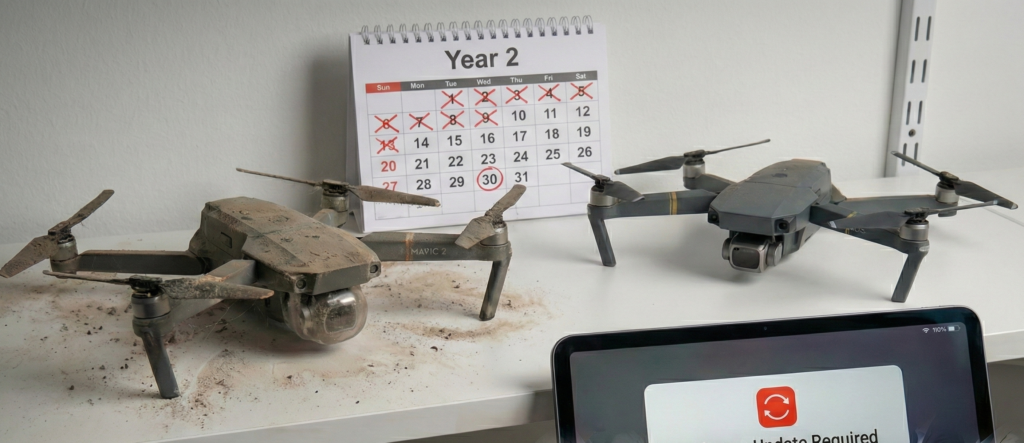
Many organizations treat drone investment like buying office furniture—make the purchase, set it up, and you’re done. But drones aren’t furniture. They’re part of an ongoing operational capability that requires continuous investment and evolution.
The Problem:
- Initial investment doesn’t include ongoing costs
- Technology becomes outdated quickly
- Skills and processes don’t evolve
- Integration with other systems is neglected
- Value creation stops after initial deployment
The Hidden Costs
Organizations that treat drones as one-time purchases discover hidden costs:
Ongoing Expenses:
- Equipment maintenance and replacement
- Software licenses and updates
- Training and certification renewal
- Insurance and regulatory compliance
- Data storage and processing
- Integration with existing systems
Opportunity Costs:
- Stagnant capabilities while technology advances
- Missed opportunities for expanded applications
- Inability to scale successful use cases
- Falling behind competitors who evolve
What Continuous Investment Looks Like
Successful organizations treat drone capability as an evolving asset:
Year 1: Foundation
- Initial equipment and training
- Pilot programs for key use cases
- Basic integration with existing systems
Year 2: Expansion
- Additional sensors and capabilities
- Expanded use cases based on Year 1 learnings
- Deeper system integration
- Process optimization
Year 3: Optimization
- Advanced analytics and automation
- Predictive capabilities
- Full workflow integration
- Strategic competitive advantage
The Key: Plan for evolution, not just initial deployment.
Mistake #3: Ignoring the Data-to-Action Gap
The Data Deluge Problem
Drones are excellent at collecting data. They capture thousands of images, create detailed 3D models, generate thermal maps, and produce comprehensive reports. But data alone doesn’t create value. Value comes from action.
The Problem:
- Organizations receive gigabytes of data
- Reports sit unread in inboxes
- Findings don’t translate into decisions
- Problems identified aren’t addressed
- Data collection becomes an end in itself
Why This Happens
The data-to-action gap occurs because:
1. Data Overload:
- Too much information to process
- No clear prioritization of findings
- Analysis paralysis sets in
- Important issues get lost in volume
2. Missing Integration:
- Data exists in isolation
- Not connected to decision-making systems
- Doesn’t flow into maintenance workflows
- Separate from budget and planning processes
3. Lack of Accountability:
- No clear ownership of findings
- No process for addressing issues
- No tracking of resolution
- No connection to business outcomes
Closing the Gap
Successful organizations bridge the data-to-action gap:
1. Structured Reporting:
- Prioritized findings (critical, high, medium, low)
- Clear recommendations with cost estimates
- Timeline for addressing issues
- Owner assignment for each finding
2. Integration with Systems:
- Connect to maintenance management systems
- Link to budget and planning processes
- Integrate with project management tools
- Flow into decision-making workflows
3. Accountability Mechanisms:
- Track issue resolution
- Monitor action completion
- Measure outcomes and improvements
- Report on value delivered
The Result: Data becomes actionable, and actions deliver value.
Mistake #4: Underestimating the Human Factor
The Technology-Only Focus
Many organizations focus entirely on technology—drones, sensors, software—while ignoring the human factors that determine success or failure. They assume that if the technology is good, results will follow. This assumption is wrong.
The Problem:
- Technology without expertise produces poor results
- Lack of training leads to misuse and underutilization
- Resistance to change prevents adoption
- Poor communication limits value creation
- Missing skills prevent effective implementation
The Human Elements That Matter
Expertise:
- Understanding what to look for
- Knowing how to interpret data
- Recognizing problems and opportunities
- Making informed recommendations
Training:
- Technical skills for operation
- Analytical skills for data interpretation
- Process skills for integration
- Communication skills for value delivery
Change Management:
- Addressing resistance to new methods
- Building support for adoption
- Creating positive user experiences
- Fostering continuous improvement
Communication:
- Translating technical data into business insights
- Presenting findings effectively
- Engaging stakeholders
- Demonstrating value clearly
Investing in People
Successful organizations invest as much in people as in technology:
Training Programs:
- Comprehensive operator training
- Data analysis and interpretation skills
- Integration and workflow training
- Continuous skill development
Change Management:
- Clear communication of benefits
- Involvement in design and implementation
- Support during transition
- Recognition of contributions
Expertise Development:
- Building internal capabilities
- Partnering with external experts
- Knowledge sharing and collaboration
- Continuous learning culture
The Result: Technology and people work together to create value.
Mistake #5: Measuring the Wrong Things
The Activity Trap
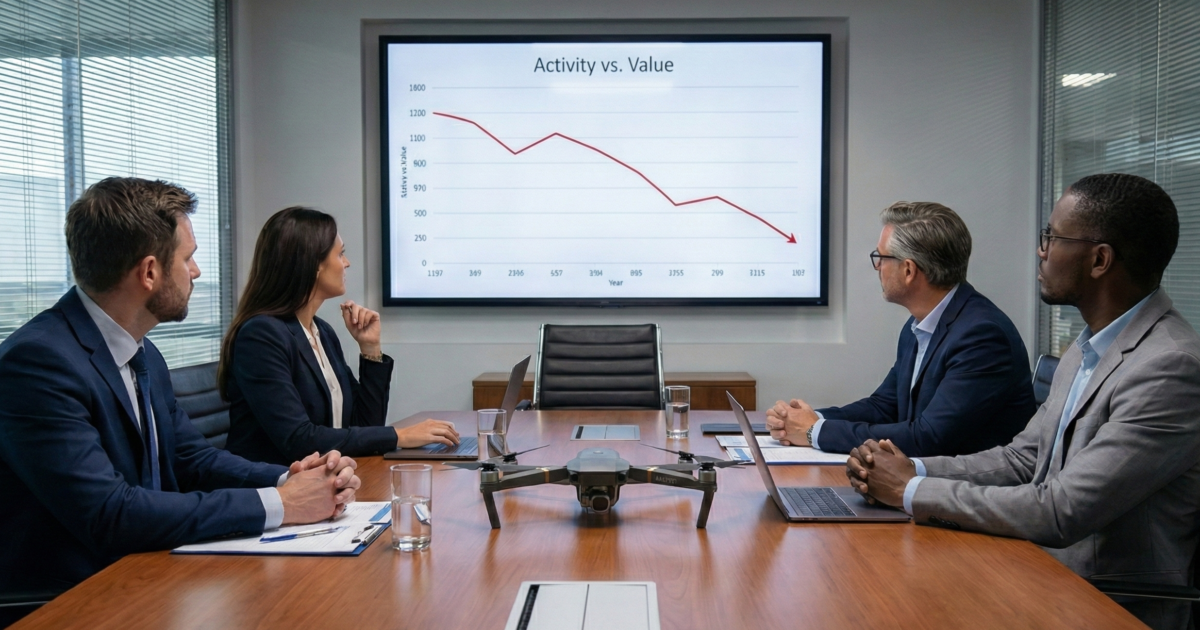
Many organizations measure drone activity—flights completed, images captured, reports generated—instead of measuring business outcomes. They track inputs and activities while ignoring outputs and results.
The Problem:
- Success is measured by usage, not value
- Activity metrics don’t reflect business impact
- ROI calculations become impossible
- Investment justification becomes difficult
- Continuous improvement lacks direction
What to Measure Instead
Business Outcomes:
- Cost reduction (time, resources, expenses)
- Risk mitigation (safety incidents, failures prevented)
- Efficiency improvements (time saved, productivity gains)
- Quality enhancements (better decisions, fewer errors)
- Revenue opportunities (new services, competitive advantage)
Value Metrics:
- ROI and payback period
- Cost per inspection/service delivered
- Time to value (how quickly benefits materialize)
- Value per dollar invested
- Competitive advantage gained
Operational Metrics:
- Issue detection rate and accuracy
- Time from detection to resolution
- Preventive maintenance effectiveness
- Decision-making speed and quality
- Process efficiency improvements
Building a Measurement Framework
Successful organizations measure what matters:
1. Define Success Criteria:
- What outcomes indicate success?
- How will we know if we’re achieving goals?
- What metrics reflect value creation?
2. Establish Baselines:
- Current state performance
- Costs and inefficiencies
- Time and resource usage
- Quality and accuracy levels
3. Track Progress:
- Regular measurement of outcomes
- Comparison to baselines
- Trend analysis over time
- Correlation with investments
4. Report and Adjust:
- Communicate results to stakeholders
- Use data to guide decisions
- Adjust approach based on findings
- Continuously improve measurement
The Result: Clear visibility into value creation and ROI.
The Self-Assessment: Are You Making These Mistakes?
Evaluate Your Drone Investment
Mistake #1: Technology-First Thinking
- ❌ Did you buy drones before identifying specific problems?
- ❌ Are drones sitting unused or underutilized?
- ❌ Do you struggle to justify continued investment?
- ✅ Fix: Start with problems, then find solutions.
Mistake #2: One-Time Purchase Mindset
- ❌ Did you treat drone investment as a single purchase?
- ❌ Are you not planning for ongoing evolution?
- ❌ Have capabilities stagnated since initial deployment?
- ✅ Fix: Plan for continuous investment and evolution.
Mistake #3: Data-to-Action Gap
- ❌ Do you receive data but don’t act on it?
- ❌ Are findings not translating into decisions?
- ❌ Is data isolated from business processes?
- ✅ Fix: Integrate data into decision-making workflows.
Mistake #4: Ignoring Human Factors
- ❌ Did you focus only on technology?
- ❌ Is there resistance to adoption?
- ❌ Are skills and training insufficient?
- ✅ Fix: Invest in people as much as technology.
Mistake #5: Measuring Wrong Things
- ❌ Do you track activity instead of outcomes?
- ❌ Can’t calculate ROI or justify investment?
- ❌ Don’t know if you’re creating value?
- ✅ Fix: Measure business outcomes, not just activity.
Scoring Your Investment
- 0-1 “Yes” answers: You’re likely avoiding major mistakes—keep focusing on value creation
- 2-3 “Yes” answers: You’re making some mistakes—address them to improve ROI
- 4-5 “Yes” answers: You’re likely wasting your investment—significant changes needed
How to Fix Your Drone Investment
Step 1: Start with Problems
Action Items:
- Identify specific problems drones can solve
- Calculate the cost of current inefficiencies
- Define success criteria and expected outcomes
- Assess whether drones are the best solution
Step 2: Plan for Evolution
Action Items:
- Budget for ongoing investment, not just initial purchase
- Plan for technology updates and capability expansion
- Design for integration and scalability
- Build continuous improvement into your approach
Step 3: Bridge the Data-to-Action Gap
Action Items:
- Structure reporting for actionability
- Integrate data into decision-making systems
- Create accountability for addressing findings
- Track resolution and measure outcomes
Step 4: Invest in People
Action Items:
- Provide comprehensive training
- Develop internal expertise
- Manage change effectively
- Build a culture of continuous learning
Step 5: Measure What Matters
Action Items:
- Define business outcome metrics
- Establish baselines for comparison
- Track progress regularly
- Use data to guide decisions and improvements
The Hard Truth
Here’s the uncomfortable reality: If you’re making these five mistakes, your drone investment is likely wasting money. The technology might work, the data might look impressive, but if you’re not solving problems, integrating into workflows, investing in people, and measuring outcomes, you’re not creating value.
The good news? These mistakes are fixable. You don’t need to abandon your investment—you need to approach it differently. Start with problems, not technology. Plan for evolution, not just deployment. Bridge the data-to-action gap. Invest in people. Measure what matters.
The difference between a wasted investment and a valuable asset isn’t the technology—it’s how you approach it.
Conclusion
Drone technology has tremendous potential to transform operations, reduce costs, improve safety, and create competitive advantages. But potential doesn’t automatically translate into value. Most organizations waste their drone investments by making the same five mistakes: buying technology instead of solving problems, treating it as a one-time purchase, ignoring the data-to-action gap, underestimating human factors, and measuring the wrong things.
If you’re spending money on drones without seeing results, these mistakes are likely why. The solution isn’t to abandon the investment—it’s to fix the approach. Start with problems, plan for evolution, bridge the data-to-action gap, invest in people, and measure what matters.
Your drone investment can deliver significant value. But only if you avoid the mistakes that waste it.
Ready to Fix Your Drone Investment?
At ZID – Zenith InnoDev, we’ve seen organizations make these mistakes—and we’ve helped them fix them. With 11+ years of engineering expertise and 4 years of specialized drone services, we understand what makes drone investments succeed or fail.
We don’t just provide drone services—we help organizations create value from their drone investments. Our approach starts with understanding your problems, then designing solutions that deliver measurable outcomes. We bridge the data-to-action gap, integrate with your systems, and help you measure what matters.
Contact us today to discuss how we can help ensure your drone investment delivers real value, not just impressive technology.
Internal Links: